The Canada Pension Plan (CPP) is one of the cornerstones of Canadian retirement security. Whether you are an employee, an employer, or running your own business, understanding how CPP contributions work in 2025 — including the newer CPP2 tier — helps you plan your finances accurately and avoid surprises at tax time. Use our free Canadian payroll deductions calculator to estimate CPP, EI, and tax per pay period.
CPP is a mandatory, contributory pension program administered by the federal government. It provides three core benefits: a retirement pension, a disability benefit for those who cannot work due to a severe and prolonged condition, and survivor benefits for the families of deceased contributors.
Almost all employed Canadians are required to contribute. The main exceptions include:
If none of those exceptions apply to you, contributions are not optional. They are calculated on your employment or self-employment income and remitted either through payroll deductions or on your personal tax return.
The 2025 CPP figures are set by the federal government annually and indexed to wage growth. Here are the key numbers every Canadian needs to know:
The formula is straightforward: you pay 5.95% on the portion of your earnings that falls between $3,500 and $71,300. The first $3,500 is exempt, and no base CPP contributions are calculated on earnings above the YMPE.
Your employer matches your contribution dollar for dollar. This means the total CPP contribution generated by a single employment relationship — where the employee earns at or above the YMPE — is $8,068.20 per year ($4,034.10 from the employee plus $4,034.10 from the employer).
Employee CPP contributions are non-refundable, but they are not wasted from a tax perspective. Your base CPP contributions generate a 15% federal non-refundable tax credit, reducing your federal tax payable by up to $605.12 in 2025 (15% of $4,034.10). Provincial credits apply on top of this. The credit is not as valuable as a deduction — it reduces tax, not taxable income — but it does meaningfully offset the cost of contributing.
If you are self-employed, CPP becomes significantly more expensive because you are responsible for both the employee and employer portions. There is no employer to share the cost — you pay the full 11.9% on your net self-employment income between $3,500 and $71,300.
The maximum self-employed CPP contribution in 2025 is approximately $8,068.20 — double what an employee pays out of pocket for the same earnings level. For someone earning $71,300 or more from self-employment, that is a substantial line item on their tax return.
The CRA does provide some relief on the tax side:
Self-employed Canadians report and pay CPP on Schedule 8 of their T1 personal tax return. Contributions are not remitted throughout the year the way payroll deductions are — the full amount is due when your balance owing is paid, typically by April 30. For higher earners, this can mean a large lump-sum payment at tax time if instalments have not been set aside.
If you are navigating self-employed CPP for the first time, or if your income has changed significantly, working with an accounting firm like Swift Accounting Calgary can help you model your instalment obligations and avoid penalties.
Starting in 2024, the federal government introduced a second tier of CPP contributions, commonly called CPP2. This is an enhancement to the original CPP enhancement that began phasing in back in 2019, and it applies to earnings above the YMPE up to a new ceiling called the Year's Additional Maximum Pensionable Earnings (YAMPE).
For 2025, the key CPP2 figures are:
CPP2 contributions are separate from base CPP contributions and have a different — and more favourable — tax treatment. Unlike base CPP, which generates a tax credit, CPP2 contributions generate a 15% federal tax deduction. A deduction reduces your taxable income rather than your tax directly. At higher marginal rates, this distinction matters: a deduction is worth more than an equivalent credit for taxpayers in higher brackets.
Employers also match employee CPP2 contributions, so the total CPP2 cost per employee (for those earning above the YMPE) reaches $848.00 combined. Payroll systems should already be configured to handle both tiers, but if you are running payroll manually or using older software, verify that CPP2 is being calculated correctly.
Every dollar contributed to CPP — both base and CPP2 — builds pensionable credits that determine your eventual retirement benefit. The benefit is calculated based on your average earnings over your contributory period and the number of years you contributed.
The maximum monthly CPP retirement pension at age 65 in 2025 is approximately $1,433. In practice, most Canadians receive considerably less than the maximum because few people contribute at the maximum rate for their entire working life. The average monthly CPP retirement pension is closer to $900.
One powerful planning lever is the start date. For every month you defer CPP beyond your 65th birthday, your benefit increases by 0.7% — that is 8.4% per year. Deferring to age 70 increases your benefit by 42% compared to taking it at 65. For those in good health with reasonable longevity expectations, deferral is often the higher-lifetime-value choice.
CPP2 contributions build entitlement to a separate additional benefit layer on top of the standard CPP retirement pension, providing incrementally higher retirement income for those who contributed above the YMPE from 2024 onwards.
Most employed Canadians cannot opt out of CPP. The rules are specific:
Carefully weigh the decision to file CPT30. Stopping contributions means forgoing additional Post-Retirement Benefits (PRBs), which permanently increase your monthly CPP payment. For those still earning significant employment income between 65 and 70, continuing to contribute may generate meaningful additional lifetime pension income. Swift Accounting can model this decision for you as part of a pre-retirement income plan.
Employers are responsible for calculating the correct CPP deduction from each paycheque, matching it dollar for dollar from company funds, and remitting the combined total to the CRA alongside income tax withholdings. Remittance frequency — monthly, quarterly, or accelerated — depends on the employer's average monthly withholding in the prior calendar year, and penalties apply for late or short remittances. The CRA's Payroll Deductions Online Calculator (PDOC) is a practical way to verify deduction amounts each pay period.
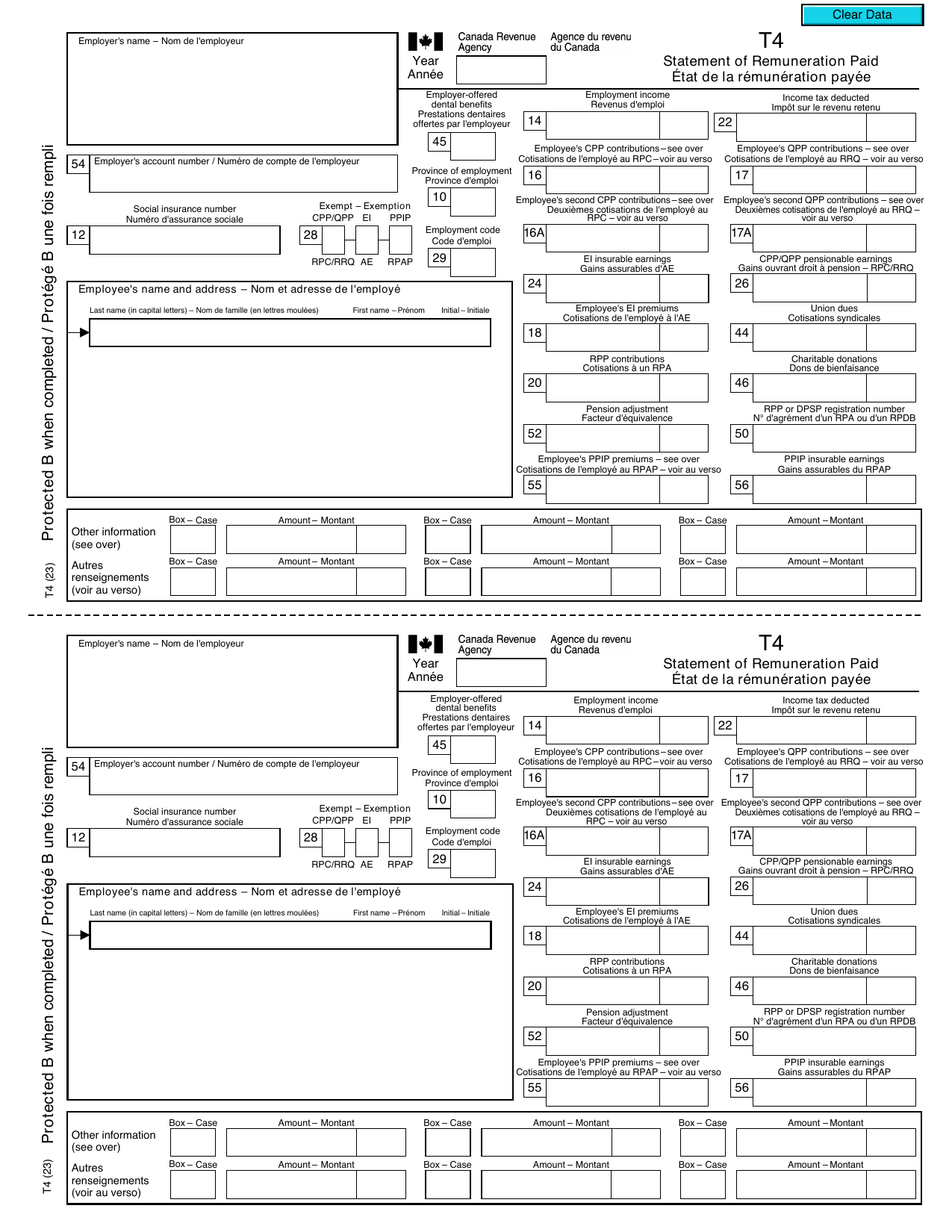
At year end, employers must issue T4 slips reporting each employee's base CPP contributions in Box 16 and their CPP2 contributions separately in Box 16A. Misreporting these two boxes — or combining CPP1 and CPP2 amounts — can trigger CRA reassessments and interest charges, so payroll software should be confirmed to be splitting the two tiers correctly.
| CPP Component | Rate | Earnings Range | Maximum Contribution |
|---|---|---|---|
| CPP1 — Employee | 5.95% | $3,500 – $71,300 | $4,034.10 |
| CPP1 — Employer | 5.95% | $3,500 – $71,300 | $4,034.10 |
| CPP1 — Self-Employed (combined) | 11.9% | $3,500 – $71,300 | $8,068.20 |
| CPP2 — Employee | 4% | $71,300 – $81,900 | $424.00 |
| CPP2 — Employer | 4% | $71,300 – $81,900 | $424.00 |
| CPP2 — Self-Employed (combined) | 8% | $71,300 – $81,900 | $848.00 |
The maximum base CPP contribution for an employee in 2025 is $4,034.10. This applies to earnings between the $3,500 basic exemption and the YMPE of $71,300, at the 5.95% employee rate. If your employment earnings also exceed the YMPE and reach up to the YAMPE of $81,900, an additional CPP2 contribution of up to $424.00 applies, bringing the combined maximum employee contribution to $4,458.10.
Yes, substantially more out of pocket. Because there is no employer to share the cost, self-employed individuals pay both the employee and employer portions — 11.9% on base CPP and 8% on the CPP2 band. The maximum combined self-employed CPP contribution in 2025 is approximately $8,916.20 ($8,068.20 base + $848.00 CPP2). Partial relief is available: the employer half is deductible against business income, and the employee half generates a federal tax credit.
CPP refers to contributions on earnings between the $3,500 basic exemption and the YMPE ($71,300 in 2025). CPP2 is a second tier covering earnings above the YMPE up to the YAMPE ($81,900 in 2025). The rate is lower (4% vs. 5.95% for employees), but the tax treatment is better: CPP2 contributions generate a deduction rather than a credit, which is more valuable for higher-income earners. Both tiers accumulate future pension benefits, but on separate tracks.
Only if you are between 65 and 70 years old and currently receiving CPP retirement benefits while still working. In that case, you can elect to stop contributing by submitting form CPT30 to your employer. If you are under 65, contributions are mandatory regardless of other pension income. If you are 70 or older, contributions stop automatically by law. Before filing CPT30, consider whether the Post-Retirement Benefits you would earn by continuing to contribute are worth more than the immediate cash-flow relief of stopping.
CPP is deceptively simple on the surface but involves meaningful planning decisions — especially for the self-employed, those approaching retirement, and business owners running payroll. Getting the calculations wrong can lead to CRA penalties, missed tax credits, or a smaller retirement benefit than you expected.
Whether you need help structuring your self-employment income, reconciling CPP2 on your payroll system, or modelling the optimal CPP start date, our team is here to help. Contact Swift Accounting today to speak with a Calgary accountant who understands the details that matter.
Our Calgary team handles personal tax, corporate returns, GST/HST, payroll, and bookkeeping.
Book a Consultation