If you work from home in Canada — whether you run your own business or log in remotely for an employer — a portion of your household costs may be fully deductible on your 2025 tax return. The rules differ significantly depending on whether you are self-employed or a salaried employee, and the CRA applies them strictly. Getting the calculation right can put hundreds, or even thousands, of dollars back in your pocket. This guide walks through every requirement, the correct forms, eligible expenses, and the numbers that matter for the 2025 tax year.
The biggest mistake Canadian filers make is confusing the employee deduction rules with the self-employed ones. They share the same principle — you may only deduct the portion of your home costs that relate to your workspace — but the eligibility tests, eligible expense categories, and CRA forms are entirely separate.
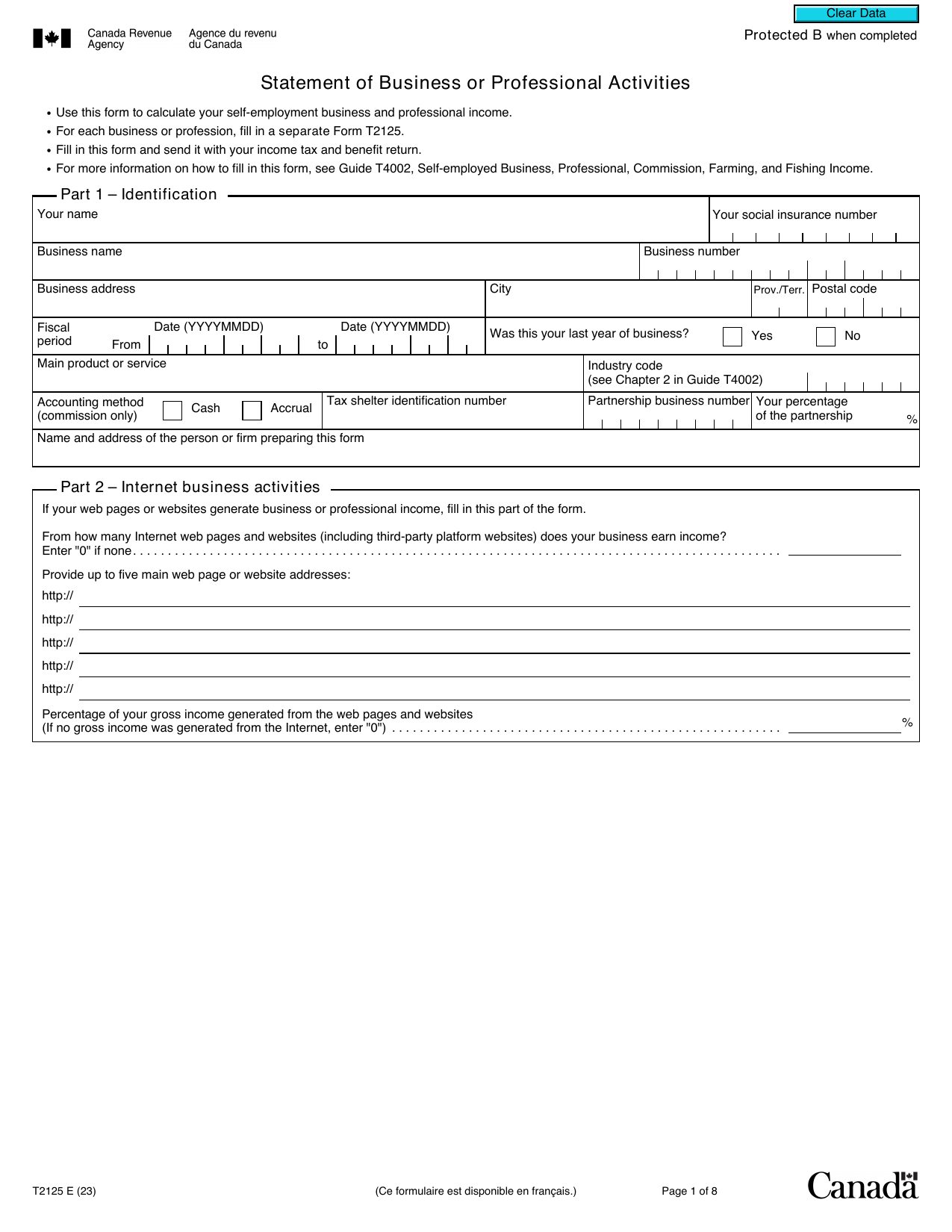
Note that the CRA's temporary flat-rate method introduced during COVID-19 was eliminated after the 2022 tax year. For 2025, every claimant must use the detailed method with supporting documentation.
Section 18(12) of the Income Tax Act allows self-employed individuals to deduct home workspace expenses only when the space is:
A dedicated spare bedroom used solely as an office qualifies. A kitchen table where you occasionally open a laptop does not. The CRA expects you to defend "exclusive use" if audited, so physical separation and consistent use matter.
The standard approach is an area-based ratio:
Workspace percentage = Square footage of office ÷ Total finished square footage of home × 100
For a 200 sq ft office in a 1,600 sq ft home, that is 12.5 %. Every eligible home expense is then multiplied by this ratio to arrive at the deductible amount.
Internet service requires a separate reasonable personal-use adjustment. If your household plan costs $120/month and you estimate 70 % business use, you claim $84/month, not the full amount.
Self-employed home office expenses cannot create or increase a business loss. Deductions are limited to your net income from the business before the home office deduction. Any disallowed amount carries forward indefinitely to future years when there is sufficient income.
Employees must meet all three of the following conditions:
The employer must complete and sign Form T2200 confirming these conditions. Hold on to this form; you do not submit it with your return, but the CRA can request it.
Employees face a narrower list than the self-employed:
The workspace percentage calculation is identical to the self-employed method: office area divided by total home area.
Consider Maya, a freelance graphic designer who has operated her business full-time from a dedicated home studio in her Calgary townhouse since January 2025. Her studio is 180 sq ft; her townhouse is 1,500 sq ft — a workspace ratio of 12 %.
Her 2025 annual household costs are:
Applying the 12 % ratio to the shared costs (excluding internet, which has its own allocation):
Total home office deduction: $4,440
At a combined federal and Alberta marginal rate of approximately 33 % on income in the lower bracket, this deduction reduces Maya's tax bill by roughly $1,465 for 2025 — real money that stays in her business.
Documentation is everything. The CRA can reassess home office claims up to three years after the original assessment (longer if there is any suggestion of misrepresentation). Keep the following for at least six years:
Home office deductions reduce your net self-employment income, which cascades through several other figures relevant in 2025:
Yes, but the two deductions must not overlap. If you rent external office space and deduct it, you may still claim your home workspace for the days or hours you use it — provided it genuinely meets the principal-place-of-business or exclusive-use test. Keep time logs to support a blended claim.
You may claim home office expenses under both T777 (for your employment) and T2125 (for your business) provided you can demonstrate the space is used for each activity and you do not double-count the same square footage or the same dollar amounts. In practice, a single well-documented workspace allocation applied to both activities is the cleanest approach.
This is a lease and insurance matter rather than a CRA question, but it is worth raising because the CRA may ask for a copy of your lease. Many residential leases prohibit commercial activity. Check your agreement and, if needed, notify your landlord or obtain a rider — running an undisclosed business from a rental could affect both your tenancy and your home insurance coverage.
Yes. Office supplies used exclusively for business — printer paper, toner, pens, postage — are deductible at 100 % of their business cost on the T2125 and are separate from the workspace percentage calculation. Only the shared household costs (utilities, rent, insurance) require the area-based ratio. Employees may also deduct office supplies on the T777 provided the T2200 confirms they are required to supply their own materials.
Home office deductions reward careful documentation and punish guesswork. Whether you are a sole proprietor running a consultancy or a salaried employee whose employer has required remote work, the 2025 rules give you a legitimate path to meaningful tax savings — but only when the workspace genuinely qualifies and the numbers are properly supported. The team at Swift Accounting Ltd. in Calgary helps self-employed professionals and remote workers structure their home office claims accurately, identify every eligible expense category, and keep documentation audit-ready. If you have questions about your specific situation or want a professional to review your T2125 or T777 before you file, reach out to us today and let us make sure you are not leaving money on the table.
```