When your business buys a vehicle, computer, or piece of equipment, you generally cannot deduct the full purchase price in the year you buy it. Instead, the Canada Revenue Agency (CRA) requires you to recover that cost gradually over several years through a system called capital cost allowance (CCA). Understanding how CCA works — which class your asset belongs to, what rate applies, and how the half-year rule reduces your first-year claim — can make a meaningful difference to your tax bill. This guide covers everything Canadian business owners need to know for the 2025 tax year.
Capital cost allowance is the tax deduction the CRA allows for the wear and tear, or depreciation, of depreciable capital property used to earn business or rental income. Unlike an ordinary expense, a depreciable asset — think a delivery truck, commercial refrigerator, or office building — provides value over many years, so its cost is spread across those years rather than written off all at once.
CCA is calculated on the undepreciated capital cost (UCC) of an asset class. Each year you apply the prescribed CCA rate to the UCC balance remaining in that class, reducing the balance going forward. You are never required to claim the maximum CCA in any given year — you can claim any amount from zero up to the maximum, which gives you flexibility to manage your taxable income.
The CRA assigns every depreciable asset to a numbered class, and each class carries a specific annual rate. The most commonly used classes for small and medium businesses are listed below.
In the year you acquire a depreciable asset, the CRA restricts your CCA claim to half the normal annual allowance, regardless of when during the fiscal year you purchased it. This is known as the half-year rule (or the 50% rule).
The logic is straightforward: because assets are purchased at various points in the year, the CRA assumes, on average, that you had access to the asset for only half the year in the acquisition period.
For example, if you purchase office equipment in Class 8 (20% rate) for $10,000, the maximum CCA you can claim in Year 1 is:
$10,000 × 20% × 50% = $1,000
In Year 2, the UCC is $9,000, and you may claim up to $9,000 × 20% = $1,800, with no further half-year restriction.
Starting with property acquired on or after January 1, 2022 and available for use before January 1, 2025, eligible Canadian-controlled private corporations (CCPCs) could claim up to $1.5 million of immediate expensing per taxation year, allowing the full cost of most depreciable property to be deducted in the year of acquisition.
For 2025, the immediate expensing incentive for CCPCs has been extended and the rules continue to apply for eligible depreciable property designated as immediate expensing property (IEP). Key points to confirm with your accountant for your 2025 return include:
This incentive can significantly accelerate cash flow for growing businesses investing heavily in equipment, technology, or vehicles.
The Accelerated Investment Incentive, introduced in 2018, suspends the half-year rule for most eligible property acquired after November 20, 2018 and available for use before 2028. Under the AII, in the year of acquisition you apply 1.5 times the normal CCA rate to the net additions in a class (i.e., the cost of new property minus proceeds from disposals).
For a piece of Class 8 equipment costing $10,000, the AII first-year claim would be:
$10,000 × 20% × 1.5 = $3,000
This compares favourably to the $1,000 available under the standard half-year rule alone. The AII phases out for property that becomes available for use after 2027 and before 2028, returning to normal rules after that.
When you dispose of a depreciable asset, the proceeds are deducted from the UCC of the class. Two important tax events can result:
Suppose a Calgary-based renovation contractor operating through a CCPC purchases the following assets in January 2025:
Using the Accelerated Investment Incentive (AII), the first-year CCA calculations look like this:
Total Year 1 CCA deduction: $25,015. If the contractor is also eligible for immediate expensing as a CCPC, they could potentially deduct the entire $56,500 in Year 1, subject to the $1.5 million limit and IEP eligibility rules. A Calgary accountant at a firm like Swift Accounting Ltd. can confirm which option maximises your after-tax position.
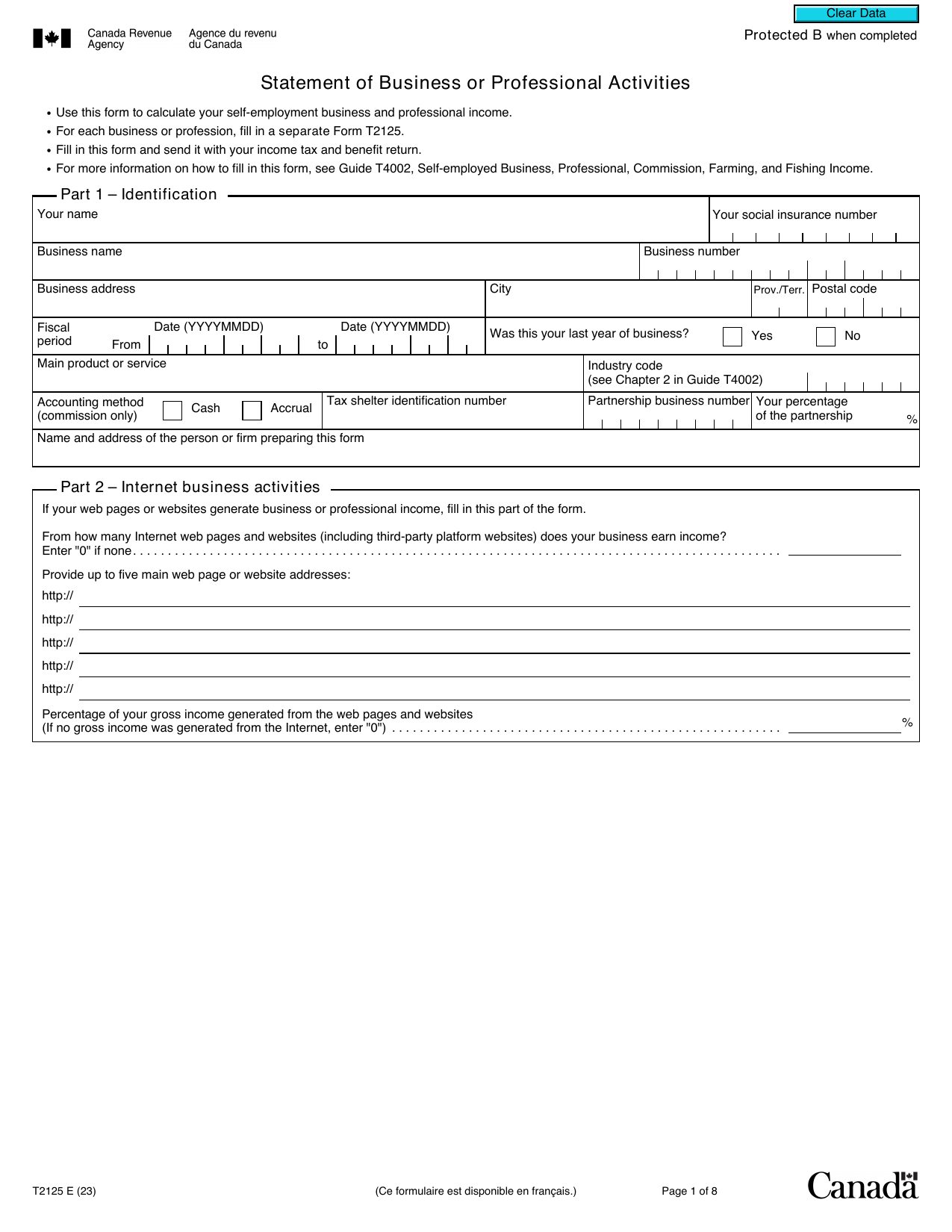
CCA is reported on Form T2125 (Statement of Business or Professional Activities) for unincorporated businesses, or on the corporate T2 return (Schedule 8) for corporations. The key steps are:
Keep detailed records — purchase invoices, dates of acquisition, and proceeds of disposal — because the CRA may request supporting documentation during a review or audit.
Generally, you cannot claim CCA on the portion of your principal residence used as a home office, because doing so could jeopardize your principal residence exemption and trigger a taxable capital gain on eventual sale. Instead, you should deduct eligible home office expenses (heat, electricity, rent, etc.) proportionally. Speak with an accountant before claiming CCA on your home.
Nothing is permanently lost. The UCC simply remains higher going into the next year, and you can claim a larger deduction then. CCA that you choose not to claim does not accumulate or carry forward as a separate balance — it is simply preserved within the ongoing UCC of the class. This flexibility is useful if you have a loss year and the deduction would provide no immediate benefit.
For most CCA classes, there is no half-year restriction on disposal — you deduct the full proceeds from the UCC in the year of disposal. The exception is Class 10.1: when you dispose of a passenger vehicle in Class 10.1, you are limited to half the normal CCA for that year, similar to the acquisition rule.
Accounting depreciation (used on your financial statements under ASPE or IFRS) is calculated based on the estimated useful life of the asset according to accounting standards. CCA is a tax concept governed entirely by CRA rules and prescribed rates — the two figures will almost always differ. Your taxable income uses CCA; your financial statements use accounting depreciation. A reconciliation between the two is made on the tax return through the Schedule 1 (or T2 Schedule 1 for corporations).
Capital cost allowance rules are detailed and the consequences of errors — recapture income, missed immediate expensing claims, or wrong asset class assignments — can be costly. The team at Swift Accounting Ltd. works with business owners across Calgary and Alberta to ensure every depreciable asset is assigned to the right class, every eligible incentive is claimed, and your CCA schedule is optimised for your long-term tax position. If you have recently purchased equipment, a vehicle, or commercial property and want to confirm you are capturing the full deduction available to you, contact us today for a straightforward conversation about your 2025 tax year.